Is It True That Topping a Tree Makes It Grow Back Healthier and Fuller?
Contact Us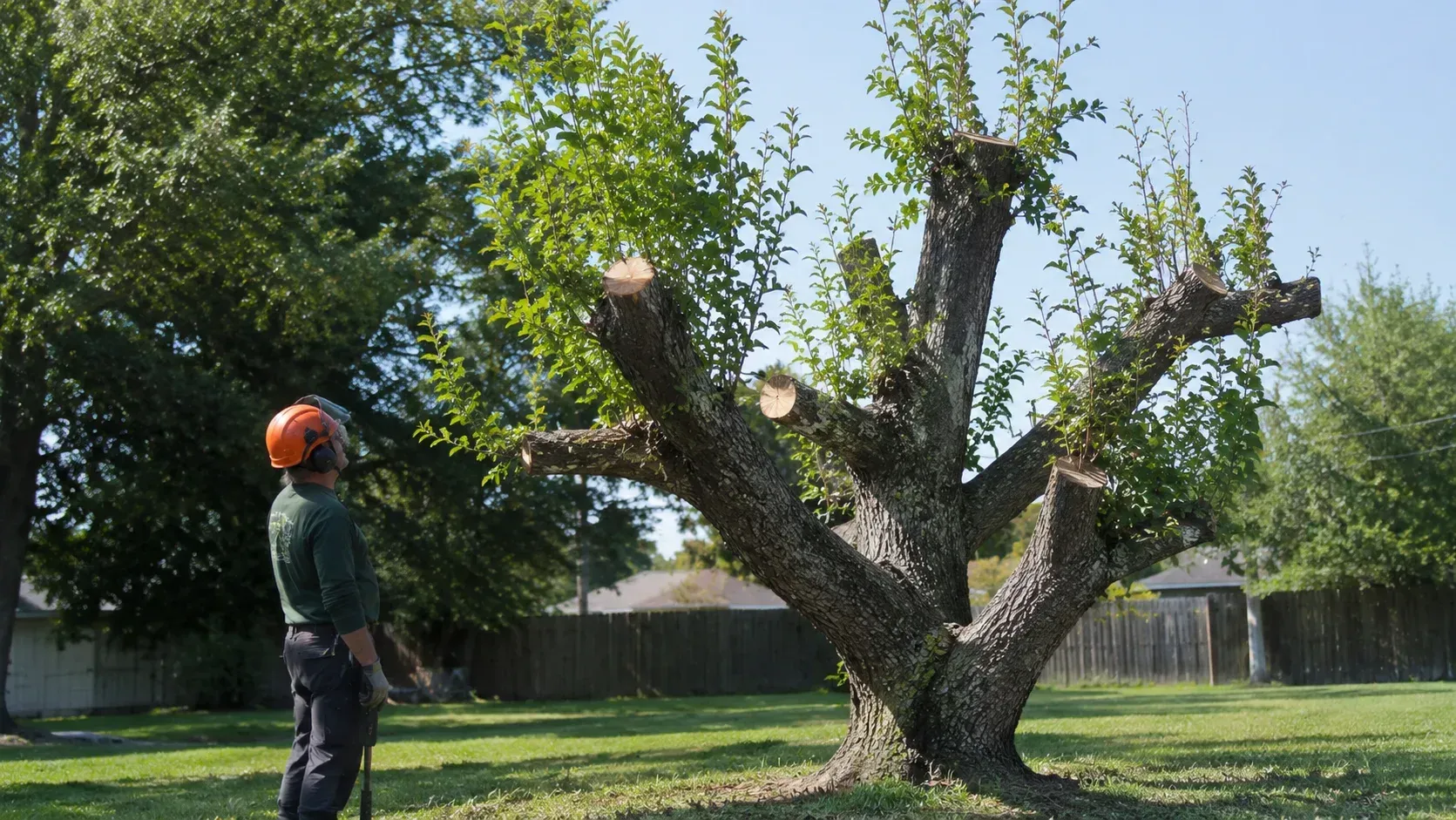
Table of Contents
- Introduction
- No, and the Regrowth Is the Evidence
- What Tree Topping Does to the Tree
- Why Tree Regrowth After Topping Attaches Badly
- Tree Topping Damage That Shows Up Years Later
- What to Ask For Instead
- When a Tree Genuinely Needs to Be Smaller
- Conclusion
- Ask About Structural Trimming Instead
- Frequently Asked Questions
Key Takeaways
- No. Topping does not make a tree healthier. It forces a flush of weakly attached shoots from stored energy the tree needed elsewhere.
- The thick regrowth people point to as proof is a stress response, not recovery.
- Large topping cuts do not heal over the way a proper cut does, which leaves a long-term entry point for decay.
- Shoots that grow after topping attach poorly and are more likely to break in a storm, which is the opposite of what topping was meant to prevent.
- Reducing a tree's size can be done correctly. That work is not topping, and it is worth knowing the difference before you hire anyone.
Introduction
No. Topping a tree does not make it grow back healthier or fuller. It forces the tree to push out a flush of weakly attached shoots using stored energy reserves, and it leaves large cuts that never properly close, which opens the trunk and limbs to decay. The result is a tree that is more likely to break apart in a future storm, not less.
The confusion is understandable, because a topped tree does produce a lot of new growth fast. That growth is the tree reacting to an injury, and mistaking it for health is the single most expensive misunderstanding in tree trimming.
No, and the Regrowth Is the Evidence
Topping means cutting large limbs or the main leader back to stubs, with no regard for where the tree's natural branch structure is. That last part is what makes it topping rather than pruning.
A properly made cut goes back to a branch collar or to a lateral branch big enough to take over as the new leader. The tree can seal that wound and the remaining branch keeps the limb growing in a sensible direction.
A topping cut goes through the middle of a limb and leaves a stub. There is no branch collar there to seal the wound, and nothing left to direct growth. So the tree does the only thing it can, which is push dormant buds along the stub into a crowd of fast vertical shoots.
That crowd is the evidence. A tree that was genuinely helped would not need to respond that way.
What Tree Topping Does to the Tree
Tree topping removes a large share of the canopy at once, which takes away the leaves the tree uses to make food, and the tree pays for that twice.
What happens in sequence:
- The canopy is gone, so photosynthesis drops sharply.
- The tree spends stored reserves from the trunk and roots to put out emergency foliage.
- Those reserves were the tree's buffer against drought, pests, and disease, and now they are spent.
- Newly exposed bark that was shaded for decades can scald in direct sun, which is a real issue in South Texas heat.
- Decay begins at the stubs, which cannot seal over.
- Root growth slows, because roots are supported by the canopy that is no longer there.
A tree in that state is not stronger. It is a tree running on its savings with open wounds, which is why topped trees often decline for years before anyone connects the decline to the cut.
Why Tree Regrowth After Topping Attaches Badly
The new shoots look vigorous and they are structurally weak, and the reason is in how they attach.
Normal branches grow from the start as part of the limb, with wood layers that interlock at the union. Shoots that erupt from dormant buds along a cut stub attach only at the surface, to wood that is often already decaying beneath them.
So you get shoots that:
- Grow fast, because the tree is racing to replace leaf area
- Attach shallowly rather than being anchored into the limb
- Crowd each other, competing in a dense cluster
- Reach a heavy, wind-catching size within a few years
- Sit on top of wood that is decaying from the cut
Put those together and you have the actual risk. Our own post on whether DIY trimming is safe on large trees puts it plainly: the new shoots that sprout after topping attach poorly and tend to break off.
On the coast that matters more than it does inland. The reason most people top a tree is fear of storm damage, and topping produces exactly the kind of growth that storms take out.
Tree Topping Damage That Shows Up Years Later
Topping damage is slow, which is why the practice survives. The bill arrives long after the crew that did it has gone.
| What was done | What shows up later |
|---|---|
| Large stub cuts left open | Decay working into the limb and trunk |
| Canopy removed at once | Stored reserves spent, slow decline, pest vulnerability |
| Dense shoot regrowth | Heavy, poorly attached limbs that fail in wind |
| Bark newly exposed to sun | Sunscald and cracking on previously shaded wood |
| Natural form destroyed | Permanent change in shape, and lower property value |
| Repeated topping to control regrowth | Each round costs again and compounds the decay |
That bottom row is the trap. Topping creates the regrowth that seems to require more topping, and the tree gets weaker with each cycle while the bills keep coming. The cheap trim is rarely the cheap outcome.
What to Ask For Instead
Ask for selective, structural trimming, and ask where the cuts will be made.
What good work involves:
- Removing dead, damaged, diseased, and poorly positioned branches first
- Cutting back to a branch collar or to a lateral large enough to take over
- Thinning to let wind pass through the canopy rather than shortening everything
- Keeping removal within a modest share of the live canopy in any one season
- Preserving the tree's natural shape rather than imposing a flat top
- Timing the work for the species and its condition
Two questions tell you most of what you need to know about whoever is quoting: where will the cuts be made, and how much of the live canopy is coming off? A crew that answers both specifically is thinking about the tree. A crew that offers to "take the top down" by a set number of feet is describing topping with a nicer word.
When a Tree Genuinely Needs to Be Smaller
Sometimes a tree really is too big for its spot, and that is a legitimate problem with a legitimate answer that is not topping.
Proper size reduction works by cutting back to laterals that can take over as new leaders, removing height gradually over more than one season, and keeping the tree's form recognizable. It takes longer, it costs more per visit, and the tree survives it.
It is also worth saying plainly that some situations are past that point:
- A tree outgrowing a space that was never going to fit it
- Significant existing decay in the trunk or main limbs
- A tree already topped repeatedly, with heavy regrowth on rotting stubs
- A tree whose structure threatens a roof or a power service
In those cases the honest answer is sometimes removal rather than another round of cuts, and we would rather tell you that than take money for work that does not solve anything. For general guidance on pruning standards, the International Society of Arboriculture is the authority worth consulting, and any crew that bristles at the question is telling you something.
Conclusion
The flush of growth after tree topping is a stress response, not a comeback. The cuts do not seal, decay gets in, the stored energy that funded the regrowth is gone, and the shoots that replaced the canopy are the limbs most likely to come down in the next storm. If a tree needs to be smaller, that can be done properly, over time, with cuts made to laterals that can carry the limb. Ask where the cuts are going before anyone starts, because topping is a decision you live with for the rest of the tree's life.
Ask About Structural Trimming Instead
If someone has quoted you on taking the top out of a tree, it is worth a second opinion before the saw comes out. Tree Care Express Services trims selectively and will tell you honestly what a tree needs, including when the answer is that it needs less work than you expected. Call (361) 283-2840, Monday through Friday, or
send us a photo of the tree and the space around it. We work across Corpus Christi, Nueces County, and the surrounding South Texas communities.
Frequently Asked Questions
Does topping a tree make it grow back fuller?
It produces a lot of new growth, which is not the same thing. Those shoots come from stored energy and attach poorly to the cut stubs, so the tree ends up denser in the short term and structurally weaker in the long term.
Is tree topping ever acceptable?
Rarely, and generally only in emergency situations involving immediate hazards. For ordinary size concerns, selective reduction back to suitable lateral branches does the job without leaving open stubs. If a crew proposes topping for routine work, get a second opinion.
Why do people still top trees?
It is fast, it is cheap, and it looks decisive. Fear of storm damage drives most of it, which is the irony, since the regrowth topping creates is more likely to fail in wind than the canopy it replaced.
Can a topped tree be fixed?
Sometimes it can be improved. Restoration pruning over several seasons thins the crowded shoots and selects the best-attached ones to become new limbs. It does not undo the decay in the old cuts, and it takes years rather than one visit.
What is the difference between topping and crown reduction?
Topping cuts limbs back to stubs with no regard for branch structure. Crown reduction cuts back to a lateral branch large enough to take over as the new leader, so growth continues in a sensible direction and the wound can seal. Same goal, very different outcome.