How Often Should Palm Trees Be Trimmed in Corpus Christi, Texas?
Contact Us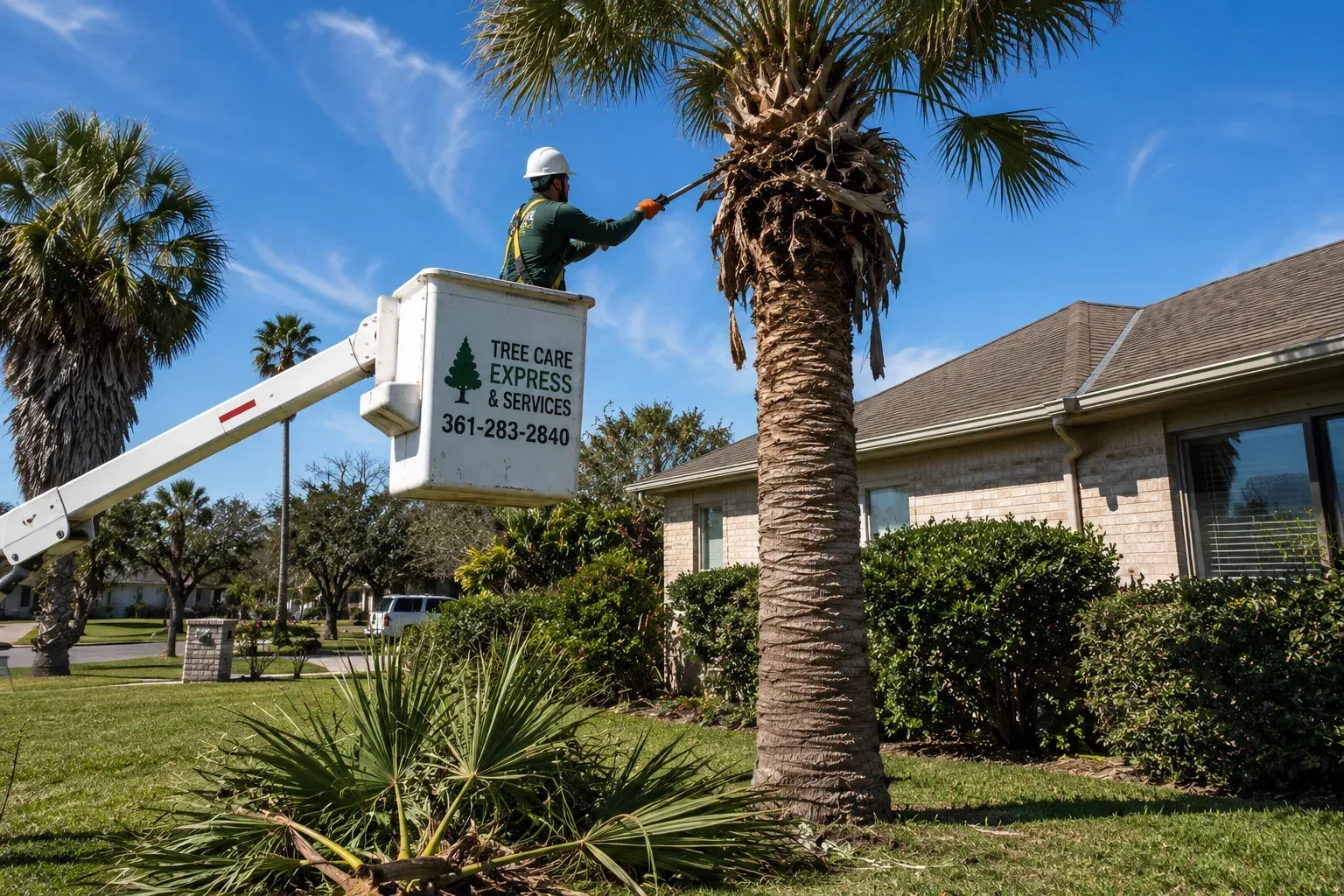
Table of Contents
- Introduction
- The Short Answer: Once a Year for Most Palms
- Why Timing Matters on the Gulf Coast
- How Species Changes the Schedule
- What Should Actually Be Removed
- The Over-Trimming Problem
- Signs Your Palm Is Due for a Trim
- DIY Trimming vs. Hiring a Crew
- Conclusion
- Book a Discovery Call
- Frequently Asked Questions
Key Takeaways
- Most palm trees in Corpus Christi need trimming once a year, usually in late spring before hurricane season begins in June.
- Only brown, fully dead fronds and fruit stalks should come off. Removing green fronds weakens a palm and slows its growth.
- Species matters. Fast growers like Mexican fan palms may need attention yearly, while sabal palms can sometimes go two years between trims.
- Over-trimming, often called hurricane cutting or pineapple cutting, is one of the most common palm care mistakes on the Gulf Coast and does more harm than good.
- Trimming tall palms involves ladder work, heavy fronds, and sometimes power line clearance, which is why much of this work goes to professional crews.
Introduction
Most palm trees in Corpus Christi should be trimmed once a year, ideally in late spring, and only to remove fronds that are fully brown along with seed pods and fruit stalks. Palms that grow quickly or sit in high-visibility spots may justify a second light cleanup, while slow-growing sabal palms can often go 18 to 24 months between trims.
The once-a-year guideline surprises a lot of property owners, because palms along the Coastal Bend are frequently trimmed far more often than they need to be, and far more aggressively. A palm is not a shade tree. It grows from a single bud at the top, stores energy in its green fronds, and responds to over-pruning by getting weaker, not tidier. This guide explains how climate, species, and storm season shape a sensible palm tree maintenance schedule in Corpus Christi, and where the common mistakes happen.
The Short Answer: Once a Year for Most Palms
A healthy palm produces a predictable number of new fronds each year and sheds roughly the same number as older fronds die from the bottom of the crown. Annual trimming keeps pace with that cycle.
Some situations call for adjusting that baseline:
- Fruiting palms near patios, pools, driveways, or sidewalks may need a mid-year visit just to remove seed stalks. Date palms and queen palms drop messy fruit that stains concrete and draws pests.
- Fast-growing species like the Mexican fan palm can hold a large skirt of dead fronds within a single season.
- Palms near walkways or structures are usually kept cleaner than palms at the back of a lot, because falling fronds land where people walk.
The important point is that frequency should follow the palm's condition, not the calendar alone. A palm with no brown fronds does not need trimming, no matter how long it has been.
Why Timing Matters on the Gulf Coast
In Corpus Christi, the best window for annual palm tree trimming is late spring, roughly April through early June. That timing accomplishes two things at once.
First, it clears dead fronds and seed stalks before hurricane season peaks. Loose, dead fronds are the part of a palm most likely to tear off in tropical storm winds and become airborne debris. Removing them ahead of storm season reduces what the wind has to work with.
Second, spring trimming happens after any winter cold damage is fully visible. Corpus Christi winters are mild, but occasional hard freezes, like the February 2021 event, burn palm fronds badly. Fronds that look dead in February sometimes still feed the tree, so the standard advice after a freeze is to wait for new growth before cutting.
Trimming in late fall or winter is generally the worst option here. It strips the frond layers that insulate the bud during a freeze, right as the palm enters its slowest growth period.
How Species Changes the Schedule
Corpus Christi's streets and yards hold a handful of common palm species, and they do not all age at the same speed.
Sabal Palms (Texas Sabal and Cabbage Palm)
These natives are slow growers and among the most wind-tolerant palms on the coast. Many sabals need only a light cleanup every 18 to 24 months, and their fronds hold on stubbornly, so what looks untidy is often still partially green.
Mexican Fan Palms (Washingtonia robusta)
The tall, skinny palms that line so many Corpus Christi streets. They grow fast, sometimes several feet a year, and build a thick skirt of dead fronds. Once a year is the practical minimum, and the height makes this bucket truck or climber work, not ladder work.
Queen Palms
Faster to shed and heavy fruit producers. Queen palms usually need annual trimming plus seed stalk removal, and they show nutrient deficiencies more readily in local soil, which a trim will not fix.
Date Palms (Canary Island and True Date)
Slow growing but high maintenance because of their sharp frond bases and heavy fruit stalks. Most owners have these professionally trimmed once a year, since the spines at the frond base can cause serious puncture wounds.
What Should Actually Be Removed
A proper trim is more restrained than most people expect. The target list is short:
- Fully brown, dead fronds. These no longer feed the tree.
- Seed pods, flower stalks, and fruit clusters. Removing these redirects energy to growth and cuts down on mess and pests.
- Hazard fronds. Anything broken, hanging, or touching a roof, fence, or service line.
Green fronds stay. A palm manufactures its food in those fronds and pulls nutrients out of aging ones before they die, which is why fronds yellow gradually. Cutting a yellowing frond early removes nutrients the palm was still using. The standard among certified arborists is the 9-to-3 rule: the remaining crown should span at least from nine o'clock to three o'clock, like the top half of a clock face. Many healthy palms are left fuller than that.
The Over-Trimming Problem
Drive through any Corpus Christi neighborhood in early summer and you will see palms cut into tight "pineapples," with only a small tuft of upright fronds left at the top. This practice goes by several names: hurricane cutting, over-lifting, or pineapple trimming. It is common, and it is harmful.
Research from the University of Florida's horticulture program has shown that over-trimmed palms are actually more vulnerable in high wind, not less. A full crown flexes and sheds wind load. Stripping it concentrates stress on the few remaining fronds and exposes the bud, the single growing point the palm cannot live without.
Over-trimming also starves the tree, narrows the trunk at the point of the cut (a permanent defect called pencil-pointing), and opens wounds that invite weevils and fungal disease. A palm treated this way year after year declines slowly and can end up needing tree removal a decade before its time.
Signs Your Palm Is Due for a Trim
Rather than watching the calendar, watch the tree. A palm is ready for maintenance when you notice:
- A visible layer of brown fronds hanging below the green crown
- Seed stalks or fruit clusters forming or already dropping
- Fronds resting on a roof, fence, or utility line
- A skirt of dead material dense enough to shelter rats or invasive species
One caution: fronds yellowing across the whole crown, rather than just at the bottom, usually point to a nutrient deficiency, most often potassium or magnesium in this region. That is a soil issue, and trimming the discolored fronds makes it worse. Broader lawn care and soil practices around the palm affect its health as much as the pruning schedule does.
DIY Trimming vs. Hiring a Crew
Short palms with fronds you can reach from the ground are reasonable DIY projects with a clean, sharp pruning saw. Beyond that, the risk profile changes quickly.
Tall palms combine several hazards: ladder work at height, fronds that weigh far more than they look, spined frond bases on date palms, and in older Corpus Christi neighborhoods, proximity to power lines. Dead frond skirts on fan palms can also release all at once when disturbed. Professional palm trimming crews work from bucket trucks or with proper climbing systems, and any work near a service line belongs to the utility or a qualified line-clearance crew.
There is also a skill component. Knowing which fronds to leave matters as much as knowing which ones to cut, and a bad trim cannot be undone. The palm has to grow its way out of it, which takes seasons.
Conclusion
For most Corpus Christi properties, once-a-year palm trimming in late spring is the right rhythm: after freeze damage is visible, before hurricane season arrives. Fast growers and fruiting palms may need a second light visit; slow sabals may skip a year entirely. The trim itself should be conservative, limited to dead fronds, seed stalks, and genuine hazards, with the green crown left full.
The biggest risk to palms in this region is not neglect. It is enthusiasm, in the form of hurricane cuts and pineapple trims that weaken the tree in the name of protecting it. Judge your palm by its condition, keep the 9-to-3 rule in mind, and be skeptical of anyone eager to remove green fronds. A palm maintained with restraint tends to need less intervention over its lifetime, not more.
Book a Discovery Call
If you are unsure whether the palms on your property are due for maintenance, or you want a second opinion on how they have been trimmed in the past, a short conversation can help you sort it out. Tree Care Express Services works with palms of all sizes across Corpus Christi and the surrounding Coastal Bend area, and there is no obligation attached to asking. You can reach out through the
contact page or call (361) 283-2840, Monday through Friday, 8am to 7pm.
Frequently Asked Questions
How often should palm trees be trimmed in Corpus Christi?
Once a year for most species, ideally in late spring before hurricane season. Fast-growing or heavily fruiting palms may need a second light cleanup, while slow-growing sabal palms can often go 18 to 24 months between trims.
What is the best month to trim palm trees in South Texas?
April through early June is the most practical window. By then, any winter freeze damage is fully visible, and dead fronds come off before peak tropical storm season begins.
Should green fronds ever be removed from a palm?
Only when a green frond is broken, diseased, or creating a genuine hazard, such as touching a power line. Green fronds feed the palm, and removing healthy ones weakens the tree.
Does trimming a palm tree help it survive a hurricane?
Removing dead, loose fronds before storm season does reduce flying debris. Stripping the crown down to a few upright fronds does not help and has been shown to make palms more vulnerable to wind damage, not less.
Why is my palm turning yellow all over instead of just at the bottom?
Crown-wide yellowing usually points to a nutrient deficiency, commonly potassium or magnesium in Gulf Coast soils, rather than a trimming issue. A soil test and palm-specific fertilizer are the typical starting points, and cutting the yellow fronds tends to make the deficiency worse.
How much does it cost to trim a palm tree?
Cost depends mainly on height, access, species, and how much dead material has built up. A short palm in an open yard costs far less than a 40-foot fan palm near power lines. Most companies will quote after seeing the specific tree.
Can a palm tree recover from being over-trimmed?
Often, yes, but slowly. A palm cannot regrow removed fronds; it has to produce new ones from the top, which can take several seasons. During that period the tree is more exposed to wind, sunscald, pests, and cold. The best response is to stop aggressive trimming and let the crown fill back in.